Telemedicine App Development in 2026: Features, Benefits, & Development Process
Updated: 5 Aug 2026
188 views
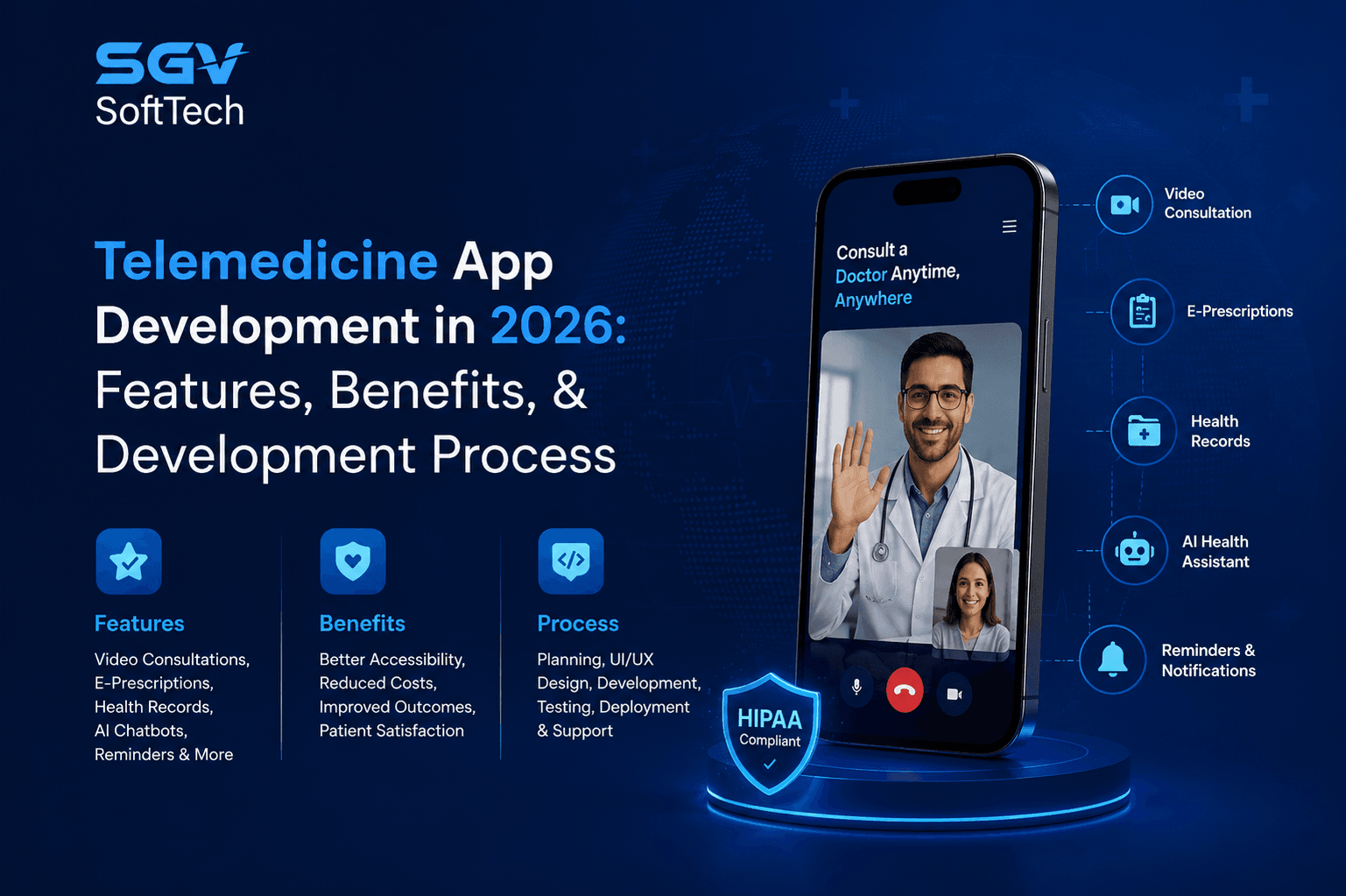
Intro
Imagine you can consult a doctor, prescribe and medication without leaving your home? Sounds so convenient.
The way technology evolves in the healthcare industry, from medicine delivery apps to remote patient monitoring. Telemedicine app development services make it easy to access digital healthcare solutions for patients.
From regular checkups, remote patient monitoring, EHR integrations, e-prescribing, and appointment scheduling, it provides everything virtually.
In this article, we’ll understand how a telemedicine app enhances the healthcare services, cost, essential features, and development process.
Quick Telemedicine Market Insight
The Asia Pacific region is the fastest-growing telemedicine market.
The telemedicine market size is projected to be $380.33 billion by 2030 at a CAGR (2025-2030) 17.55%.
Real-time consultations contributed to the largest revenue share in 2024, which shows high demand for telemedicine app development services.
Define Telemedicine App Development Solutions
Telemedicine app development services provide remote patient care by enabling online consultations, e-priscribing and EHR integrations. The elements in a telemedicine app are:
- Virtual Consultations
- Real-time Communication
- EHR Integrations
- Appointment Scheduling
- E-pricribing
How Telemedicine Apps Work?
Through telemedicine app development solutions, patients can directly consult with medical professionals, and they are highly effective for general care and non-emergency conditions.
From the patient panel, users can book and schedule an appointment with health specialists for general care, remote monitoring, chronic disease management and mental health.
From the health providers panel, medical professionals who have a medical license can create a profile and provide remote services to patients. They can see the patients' schedules, updates, and availability.
Benefits of Telemedicine App Development
Telemedicine apps beneficial for patients and providers both. These apps provide accessible, convenient and efficient virtual consultations. It saves money and time by reducing travelling costs and waiting time.
For Patients
- Convenience: Patients can consult with a doctor remotely anytime, anywhere. With telemedicine apps, patients can easily access medical services.
- Lower Medical Cost: Telemedicine apps reduce the expenses of transportation due to online consultation.
- Remote Consultations: Patients don’t have to visit the hospital for general medication. They can book appointments for disease advisory.
For Healthcare Providers
Telemedicine app development solutions help healthcare providers to manage their workflows, enhance medical services, and gain access to patients' medical records.
- Improve operational efficiency: With telemedicine apps, automate the tasks, optimise the doctor’s scheduling and manage clinical workflows.
- Cost-effectiveness: Providers don’t require a clinic or physical space for consultations with patients. It also reduces staff costs, saves time, and allows providers to see more patients.
- Expand the user reach: Patients can book an appointment and take virtual consultations from anywhere through telemedicine app development services. It provides digital solutions beyond geographical location.
- Easy to manage the patient’s medical record: With EHR integration, medical professionals can easily access and analyse patients ' records and reports.
Types of Telemedicine Apps and Their Uses
In the healthcare market, there is a wide range of telemedicine app development solutions, such as teletherapy, on-demand, store-forward, etc.
A healthcare app development company offers to create a custom telemedicine app with specialised features.
On-demand Virtual Consultations: These apps are dedicated to virtual consultations via video calls/chat in real time. The patient can directly speak with the doctor/specialist and receive immediate advice. For example: Flu, cold, fever.
Remote Patient Monitoring (RPM): RPM focus on monitoring patients remotely through wearable devices and smart sensors. It is ideal for managing chronic conditions, daily cardiac patients’ heart rates, diabetes patients, and blood pressure.
Teletherapy & Mental Health App: These teletherapy apps offer one-to-one conversations with a certified psychiatrist and therapist for mental health diseases and healing sessions.
Store & Forward Telemedicine Healthcare App: The patient can send their medical records and diagnosis report to the doctor for consultations.
Niche-specific App: Niche-based telemedicine apps primarily focus on special medical conditions and diseases rather than general care.
It provides tailor-made solutions with specialised features. Example: chronic disease management, dermatology, women’s health, and child care.
Must-have Features in a Telemedicine App Development Solution
A telemedicine application includes patients and medical professionals to connect through a video call or chat.
Modern telemedicine software development services also offer EHR integration, e-prescribing, virtual video calls, and real-time availability to help providers manage workflows, operational efficiency, and scheduling.
Features for Patients
Simple User Registration: Create a simple but full health detail registration process for patients.
High-Quality Virtual Consultations: high-quality virtual consultations to prevent the wrong diagnosis, clear communication, and doctors can see clear disease symptoms like breathing patterns, swelling and rashes.
Health Profile/ Portal: A patient’s health portal is necessary to store medical records(easily accessible whenever needed), book visits, and manage health information.
Smart Monitoring (RPM): Patients can monitor their health through smart monitoring devices such as smart watches, symptom logging and bands to check blood pressure, heart rate, and sugar level.
E-prescribing/ Invoice: Reduce manual paper trails, correct medicine dosage and integrate with clinicals for correct medications.
Real-time messaging and reminders: Real-time notifications, in-app messaging and reminders to remember schedule appointments, dosage time and virtual consultations reminders.
Secure and multiple payment gateways: Secure payment transactions to easily make appointment bookings, consultation fees and insurance fees.
24/7 Availability: Provide a feature for real-time availability for immediate medical attention & urgent care.
Symptoms Checker: It accesses patients’ health input by AI and guided surveys to check the early symptoms of the diseases.
Features for Telemedicine Providers
EHR Integrations: Directly sync the medical information of the patient to the doctor to check the patient’s medical history without searching multiple systems.
Dashboards and Scheduling: Manage the doctor’s availability to prevent real-time conflicts. Healthcare providers have to digitally verify and certify medical information to allow consultations.
E-priscribing: Telemedicine professionals can prescribe medications to patients' preferred medical providers. It can help to reduce errors in medications and make renewals easy.
Telemedicine Regulatory Compliance
To ensure patients’ data security, a reputable telemedicine app development company must implement healthcare regulatory compliance to build a secure telemedicine app and HIPAA-compliant software.
- HIPAA
- GDPR
- HiTECH
- SOC 2 (Service Organisation Control 2)
- PHIPA
- Telemedicine Practice Guidelines 2020 (India)
- DPDP Act (Digital Personal Data Protection Act, India)
How to Build a Telemedicine App: Step-by-Step Process?
The telemedicine mobile app development process is not as simple as an app, due to its responsibility of protecting users' sensitive data and information. It requires a proper implementation of healthcare security standards, handling massive datasets, regular maintenance, and updates.
Define requirements and Market Research.
Define the idea of your telemedicine app, like what you want to build: a general app, a mental health app, or a niche-based app.
Regulatory Compliance
Implement the health care compliance(HIPAA, HiTECH) to secure users’ (patients and providers) sensitive information and data.
Define Core Features
Finalise the core features like patient panel, doctor panel and admin panel.
Tech Stack
A telemedicine app requires robust, scalable and secure technology.
UI/UX Design
Design an interface for both patients and medical professionals. Make an intuitive, accessible, and easy-to-navigate experience for all ages.
Robust Development
Robust backend, responsive frontend, secure third-party and API integrations. Secure databases with end-to-end encryption to handle a large amount of data.
Testing & QA
Ensuring the app’s quality through performance, usability, speed, and efficiency testing.
Deploy & Launch
Release the app on the App Store (iOS) and Google Play Store.
Maintenance and Ongoing Support
Maintaining the app is crucial. Regular security patches, updates, bug and error fixes are mandatory for this.
Cost Breakdown of Telemedicine App Development
The telemedicine app development cost can differ from a simple to an advanced app. Adding more features, scalability, and technology integrations requires more budget. The estimated cost of the telemedicine app ranges between $30,000 - $300,000+.
| Telemedicine App Type | Cost Estimated |
| Basic App/ MVPs | $30,000-$80,000 |
| Mid-level App | $80,000-$150,000 |
| Advanced/Enterprise App | $150,000-$300,000+ |
Also read: Healthcare App Development Cost
Factors Influencing the Cost of Telemedicine App Development
Calculating the investment for a telemedicine application involves estimating costs. Providing an understanding of the primary cost drivers from features to strict compliance requirements is essential for accurate project planning and ensuring long-term scalability. The following factors are critical in shaping the financial roadmap for your telemedicine solution.
Features Set: The telemedicine app requires features for patients and healthcare providers. Adding more features can affect the budget.
Security and Compliance: Compromise with security and compliance is not an option in a telemedicine app. To build patient loyalty and trust, implementing regulations and guidelines is a must.
Third-party Integrations: Third-party integrations are paid services. You have to pay for the EHR system and other integrations, like video calling, push notifications, prescriptions, and integrations with medical.
Platform & Architecture: The choice of platform affects the development time and cost. To develop native apps (iOS/Android), it requires more budget, and choosing a cross-platform development is a cost-effective solution.
Team’s Location and Expertise: Cost of the telemedicine app development, geographical location, and team expertise fluctuate the budget. Hiring a full-time development team can be expensive, rather than a small one.
Maintenance & Updates: Consistent audits, identifying technical errors, bugs, and fixing them. Provide regular security updates and patches to protect users’ data from malware and fraud.
Common Challenges in Telemedicine App Development
Telemedicine applications must implement the security standards to ensure the privacy of users' data and maintain clear communication. Understanding these common hurdles can help businesses that invest in secure, reliable, scalable, and user-friendly telemedicine solutions.
Security Concerns: Because telemedicine apps need patient data for accurate health advice, they are vulnerable to cyberattacks, scams, fraud, and unauthorised access
Data Privacy: The app must be fully secure and compliant to protect sensitive data and information.
Complex Integrations: Beyond the EHR integrations, a telemedicine app requires real-time video, chat, payment gateways, and other third-party integrations complex and difficult to execute.
Managing Dual Interfaces: The telemedicine app development solution includes features for both patients and providers. Designing a dual user-friendly interface can be tricky and requires a different development approach.
Handling Real-time Availability: Real-time data sync in different time zones, availability for appointment scheduling, real-time push notifications, and reminders require a robust backend infrastructure.
EHR Integrations: Provide easy access to patients' health records to providers requires
Technology & Connectivity Barriers: High-quality video consultations depend on internet connectivity and new technology support.
Final Thoughts
As the demand for digital healthcare app development services is increasing, the medical industry is shifting from waiting in hospitals to consulting online with medical professionals.
Telemedicine services increased after the pandemic to initiate contactless medical services, remote patient monitoring, and the result of rapid digitisation.
Partner with a trusted telemedicine software development company to :
- HIPAA-compliant apps and software
- Integration of wearables technology
- Robust and secure healthcare solutions
- User-focused and intuitive design
- Modern technology integrations
To know more, read: Healthcare Mobile App Development Guide
Contact us to develop a custom telemedicine app and software.
THE AUTHOR

Ishan Ojha
CEO of SGV SoftTech
Ishan Ohja is the CEO of SGV SoftTech, a global digital development company. He specializes in web development, mobile apps, AI solutions, and custom software development. Through his blogs, he shares insights on emerging technologies, digital innovation, and strategies that help businesses succeed in the digital world.
What is Telemedicine App Development?
Telemedicine application development is the process of building software and apps to enable online consultations remotely for patients, where users can book and schedule appointments with healthcare providers. It connects patients and doctors through a real-time video call or chat.
What is the timeline for telemedicine mobile app development?
Developing a telemedicine mobile app typically takes 2 to 12+ months from an MVP to an enterprise-grade/complex app. But delivering a custom or niche-based app requires more time because of the tailor-made features.
What is the tech stack for telemedicine app development?
As a leading healthcare app and software development company, we use a scalable and robust tech stack for a strong backend to handle large and complex data.
Frontend Development Technologies Frameworks: ReactNative, Flutter, Swift/Kotlin
Backend Development Tools: Node.js, React.js, Python, etc.
Database System: PostgreSQL, MongoDB, Firebase
Read More: Frontend vs backend technologies
How much does it cost to build a telemedicine health app?
The cost of telemedicine app development is not a fixed amount. It depends on many factors, such as project scope, type of app, tech stack, integrations, feature set and security regulations.
What are the key features of a telemedicine healthcare app?
The key features include: easy user registration, real-time communication, remote patient monitoring (RPM), secure payment transactions, EHR integrations, appointment scheduling, E-prescribing, and a dashboard for health providers.
How to develop a HIPAA-compliant telemedicine app?
Developing a HIPAA-compliant telemedicine app requires a secure first architecture from the start. Include security and compliance in the development process, such as protected health information (PHI), HIPAA, HiTECH, regional and international telemedicine acts to protect users' health information.