Medication Management App Development: Features, Benefits, Challenges and Future Trends
Updated: 4 Aug 2026
168 views
Intro
In modern life, busy routines leave people little time to focus on their health. They may forget to take medicine on time or take the wrong pills, which can cause serious health issues.
A medication management app makes life easier by managing complex medications, reducing missed doses, and helping users take pills on time, especially elderly users and people with Alzheimer's or dementia. It also educates users about medications, side effects, precautions, and ways to prevent health risks.
Businesses increasingly invest in healthcare app development services to develop a medication management app to improve patient care and increase operational efficiency.
In this guide, we’ll cover everything about medication management app development, essential features, user-focused app types, challenges, benefits and other important aspects.
Key Takeaways
- Through the medication management app, users can easily set reminders or schedules to take their medicines on time.
- Physicians and healthcare providers can monitor patients remotely through wearable devices and streamline their workflows.
- The cost of developing a medication management app can typically range from $10,000-$190,000+, from a simple to an advanced system.
- As a medication management app, organise and schedules, and it stores the medical reports and prescriptions, that raise a security concerns about user data.
- Start small projects to get user feedback, then scale the app later.
Market Overview of Medication Management App Development
- The medication management market is projected to reach $12.8 billion by 2030.
- North America is the largest market in 2024.
What is a Medication Management App?
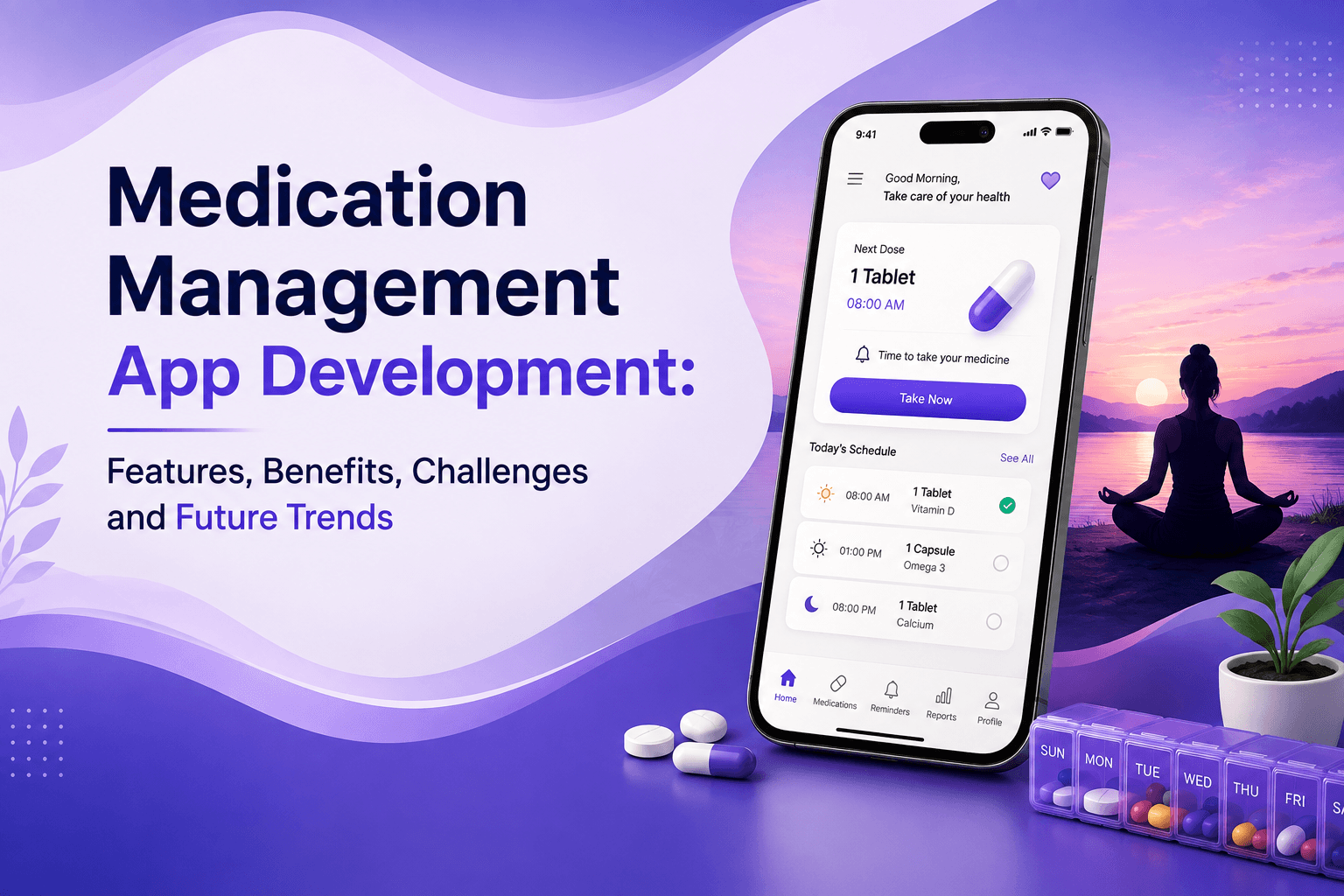
A medication management app is a digital tool that is designed to manage daily medication routines, prescribed schedules, and complex medications to reduce the risk of missed doses. It helps users to set reminders, alerts, and alarms to take medicines on time. Most of the medication management apps offer holistic solutions, not just a reminder, but also monitor physical health, drug interactions, and ensure healthcare treatment is effective.
Understanding their types can help you choose the app based on your health requirements.
Types of Medication Management Apps
Medication management app categories into various types, from a basic medication reminder app to a pharmacy integration app. Every user has different requirements; some users want a basic medication app, while others demand a customisable medication app based on their health needs.
Basic Medication Reminder App
A basic medication reminder app offers simple features, such as setting a daily dose schedule with alarms to follow the right prescription.
Example: MediSafe and MyTheraphy
Caregiver-Focused Medication App
A caregiver medication app allows a caregiver or assistant to help with complex medication schedules, alerts for missed doses, and drug interactions. It supports multiple patients and family members in coordinating medications.
Example: CareZone
Chronic Disease Management App
These apps focus on improving chronic diseases like diabetes, asthma, and high blood pressure. It's tracking the medicine metrics and help users manage chronic disease.
Pharmacy Integrated Medication App
These kinds of medication apps connect the patient and the pharmacy to manage prescriptions, track doses, drug interactions and refills seamlessly. It also helps with refill reminders, custom logs and health progress tracking.
Medication Information App
It guides and educates users on prescribed medications, dosage, and pill side effects. Also, provide precautions, storage suggestions and information on specific medicines.
Elder-Friendly Medication App
Especially built for elderly users to track their health and avoid missed pills through an automated reminder, analysing with AI to personalise the profile. Easy registration, one-tap logins, clear navigation, and large typography.
Still confused about how to select the best app for medication management? Explore our latest guide: The best medication reminder apps for 2026.
Must-Have Features in Custom Medication Management App Development
To develop a medication management app that is reliable, scalable, secure, and accessible, requires core and advanced features.
Choose features based on your app type, user demand, and business requirements. Core features offer simple pill reminders and stability, while the advanced features are the main factor that differentiates your app from others.
Basic Features
From MVPs to advanced medication management apps, these features build the foundation for long-term business growth.
User Registration & Secure Logins
It allows users to create a personalised profile to manage daily medications through email or phone numbers and manage their account and personal information. Multi-factor authentication and biometrics help protect users' healthcare data and information.
Smart Medication Scheduling
Enabling smart scheduling for multiple medications in a day, guiding users to take their doses, medications, and supplements through notifications, alerts, and reminders. Users can easily set reminders to manage prescribed medications.
Prescription and Refill Management
A medication management app also offers to store and organise prescriptions and medical history. It reduces the paperwork and minimises manual errors for effective healthcare treatment. It reminds the user to refill pills and doses before running out of stock.
Drug Usage Interaction Warning
The drug usage checker alerts users if they have any allergies to a specific chemical (Ingredient) or side effects, and provides information to reduce the potential for health risks when taking the wrong combinations of medicines at the same time.
Medical History Records
A medication management app helps users to access, organise, and store their medical records digitally for better health treatment.
Pharmacy Integrations
Most of the medication management applications integrate with the pharmacy to automate the refill process for the convenience of users.
Benefits of Medication Management App Development
From managing daily doses to refill management, a medication management app helps users, providers, and caregivers.
- Enhance medication adherence by handling complex medications, prescriptions, and scheduling multiple medications.
- Reduce missed doses by scheduling medications, push notifications, alerts, and reminders to minimise skipped doses.
- Mitigate human errors by automating scheduling.
- Seamless integration of pharmacies to refill multiple medications
- Centralised health data
- Automated prescription refills notifications
- Providers can directly monitor that if patient are taking their medicines on time or not as prescribed.
- Integrate with EHR (Electronic Health Record) for easy access to the patient's medical history. It helps healthcare professionals to understand allergies and dangerous drugs that harm patients.
- Better management of chronic disease
Process to Build a Medication Management App
To develop a medication management app, a proper strategy is required for the right execution.
A medication management app development company offers customised services and builds from scratch,
Define the Idea
To practically execute the idea, be clear about your target audience, whether you want to target the older generations, chronic care patients or caregivers.
Market and Customer Research
Conduct market research to understand the market trends, competitors' analysis and customer demand. This is a crucial phase for the medication app development because it determines the platform choice, feature set, and technology integrations.
Interactive Design
An Interactive design is vital to attract more users and increase the number of downloads of the app. Design intuitive, responsive buttons, a minimal and user-friendly interface.
The UI/UX also depends on the target audience. To design an app for the older generation, focus on a simpler design, with large and readable typography.
Development
Develop a medication management app that includes a frontend and backend services. Choosing a development technology is important for high functionality and performance.
API & Integrations
Push notifications, payment integrations, and schedule reminders require integration with third-party apps and APIs.
Security & Compliance
For any kind of healthcare app development, it is vital to ensure the data security and privacy of patients. Implement security and privacy regulations such as GDPR, HIPAA, and HITECH. Developing a HIPAA-compliant app builds reliability and ensures the security of data.
Testing & QA
Ensure the app’s functionality, quality, usability, security and performance through rigorous testing.
Deploy and Launch
Launching your app on the Google Play Store(Android) and the App Store(iOS) for users.
Maintenance and Ongoing Support
Maintaining a medication app, it requires continuous monitoring and regular auditing to fix bugs and technical errors, which makes it costly to maintain an app.
Cost of Medication Management App Development
The cost of a medication management app relies on multiple factors, including app complexity, feature set, platform selection, tech stack, third-party integrations, and maintenance.
Basic Medication Management App/MVPs: $10,000-$40,000
Mid-level Medication Management App: $40,000-$80,000
Advanced Medication Management App: $80,000-$190,000+
Read more about the Healthcare App Development Cost
Challenges in Medication Management App
While medication management apps have many advantages, such as reducing skipped doses, scheduling multiple medications, health tracking, and building healthy habits. However, the medication app also has some drawbacks. An in-depth understanding can help to overcome the challenges and ensure high performance.
Android Notification Reliability
To save battery life, Android shuts down background services that failed the scheduled reminder for medication due to a manufacturer's power-saving feature.
Solution: Use Firebase Cloud Messaging (FCM), foreground services, local notifications, alarm manager, and work manager for online-capable local notifications.
Ensure Security and Compliance
A medication management app that stores sensitive data and information but fails to meet the privacy regulations can impact user trust.
Solution: Build your medication app HIPAA-compliant. Implement all regional health regulations to protect native users' data and information. End-to-end data sync, secure cloud infrastructure, and strong app locking mechanisms like biometrics and face IDs.
Complex Design for Elderly Users
Creating a UI/UX for elderly users is difficult as they don’t know how to use an app, and multiple medications schedule can confuse them.
Solution: Simplify the design, provide easy navigation, use big buttons, and use clear and readable typography. Also, provide audio-based input for easier use.
Manual Error and Medication Inaccuracy
Manually entering the dosage, pill, and schedules can increase the risk of medication inaccuracy, which can harm patients.
Solution: Offer a feature to scan the prescription and medical reports for the right medication details.
EHR and Pharmacy Integration
EHR (Electronic health record) and pharmacy integration are important to sync medical information for the user’s caregivers and providers.
Solution: Use standard healthcare APIs to map app data that can automatically update users' data if any changes occur.
Future Trends in Medication Management App Development
Modern medical solutions integrate AI development services for more personalisation, to prevent potential risks of wrong medications, schedule doses and monitor health improvements.
Generative AI
Generative AI changes how medication reminder tools work, from static to personalised; it guides patient prescriptions, drug intake, summarises prescribed medications, helps with specific allergies, and prevents health risks.
AI & Predictive Analysis
AI analyses medication usage, treatment outcomes, and user behaviour to predict potential risks, customise medication schedules and improve disease treatment.
Wearables Integration
Connecting with smart devices such as smart watches and fitness bands to monitor health data in real-time. Notifications, alerts and reminders to reduce the skip rate of doses and medications.
Multimedia Health
In future, AI will also process images such as pill bottles, interpret doctors’ prescriptions, and analyse specific allergies and conditions by scanning.
Remote Patient Monitoring/Care
Shifting from a simple tool to advanced technology for monitoring patient health remotely through IoT-based technology, such as a smart pill, heart rate monitor, and smart inhaler. It allows the analysis of real-time, automated and data-driven treatment insights.
AI Chatbots and Assistants
Using natural language processing(NLP) helps to interpret the data, and AI chatbots can assist patients with any doubts. It builds empathy with patients, reduces the potential health risks by managing side effects and generates reports for physicians.
Check also: AI in Healthcare
How to Choose a Reliable Medication Management App Development Company?
Partner with a leading healthcare app development company to ensure that your vision aligns with customers' expectations and drives long-term success. Before hiring a company, consider the following factors:
Expertise in the Healthcare Industry
Developing a medication management app requires experience and specialises inthe healthcare industry.
Check our Experience in Healthcare App Development: Health Movement App and Website
Transparency and Reliability
From planning, designing, development, integrations, to maintenance, app development companies should focus on a transparent approach and clear communication for better project understanding to build trust among businesses (clients).
Prioritise Security and Compliance
Choose a company that prioritises security over everything and doesn’t compromise on users' privacy and data security. As a reliable company, SGV SoftTech not only leverages secure backend technologies but also implements regional healthcare guidelines, business protocols, and secure logins.
Technical Knowledge
Leveraging advanced technologies requires knowledge of modern technologies, such as frameworks, APIs, and cloud infrastructure.
Continuous Maintenance
Regular audits, continuous app monitoring, security updates, and patches are important to maintain the app's performance, enhance the features, and fix bugs and technical errors.
Conclusion
Investing in custom medication management app development is a wise decision, as it improves treatment outcomes, patient care, reduces skipped doses, minimises dangerous drug errors, and ensures safe medication use.
While choosing a feature set, combine the core features with the advanced features. Build a user-friendly, accessible, secure, and scalable medication management app.
Ensure the success of your medication management app with a leading healthcare app development company like SGV SoftTech.
THE AUTHOR

Ishan Ojha
CEO of SGV SoftTech
Ishan Ohja is the CEO of SGV SoftTech, a global digital development company. He specializes in web development, mobile apps, AI solutions, and custom software development. Through his blogs, he shares insights on emerging technologies, digital innovation, and strategies that help businesses succeed in the digital world.
What is a medication management app?
A medication management app is a digital tool that allows users to manage their medication promptly as prescribed by their doctor for fast improvement in their health conditions. Users can set reminders or alarms based on medications routine.
What features should you include to build a successful medication management app?
Features for successful medication management app development include simple user registration, secure logins, medication reminders, scheduling, dosage instructions, refill reminders, health tracking and pharmacy integrations.
Startups and MVPs should prioritise the core features for cost-effective solutions, while large health enterprises leverage advanced features.
How to ensure security and compliance in custom medication management app development?
Security and privacy should be prioritised in a healthcare app to ensure the security of sensitive health data and information. Implementing security and privacy regulations such as GDPR, HIPAA and secure EHR integration. Secure logins with strong passwords, biometrics, face IDs and end-to-end data encryption.
How long does it take to build a medication management app?
Developing a medication management app can take a few weeks to months, depending on the app's complexity, requirements, feature set, team expertise, location, and third-party integrations. However, many medication management app development companies take 2-12+ months to build a simple app to an advanced medication management application.
What is the cost of custom medication management app development?
Custom medication management app development requires tailor-made features for specific business requirements, custom design, advanced technology, built-from-scratch APIs, and a modern tech stack.