AI in Logistics: Use Cases, Benefits, Challenges & Future
Updated: 13 Aug 2026
225 views
Brief
The rise of technological advancements, developments in transportation, the trend of online shopping, smartphone usage, ecommerce platforms, and government AI initiatives are major reasons for the rapid revolutionisation in the logistics industry. Logistics is not just about delivering products; it is more than that. From supply chain management to customer relations, logistics businesses utilise AI technology at every stage to speed up the delivery process and improve efficiency.
Logistics companies and ecommerce platforms are fostering AI in logistics to accelerate fast delivery systems, automating various processes such as order scheduling, warehouse picking, packaging, adjusting drivers' paths, tracking, auto-checking returns and refunds.
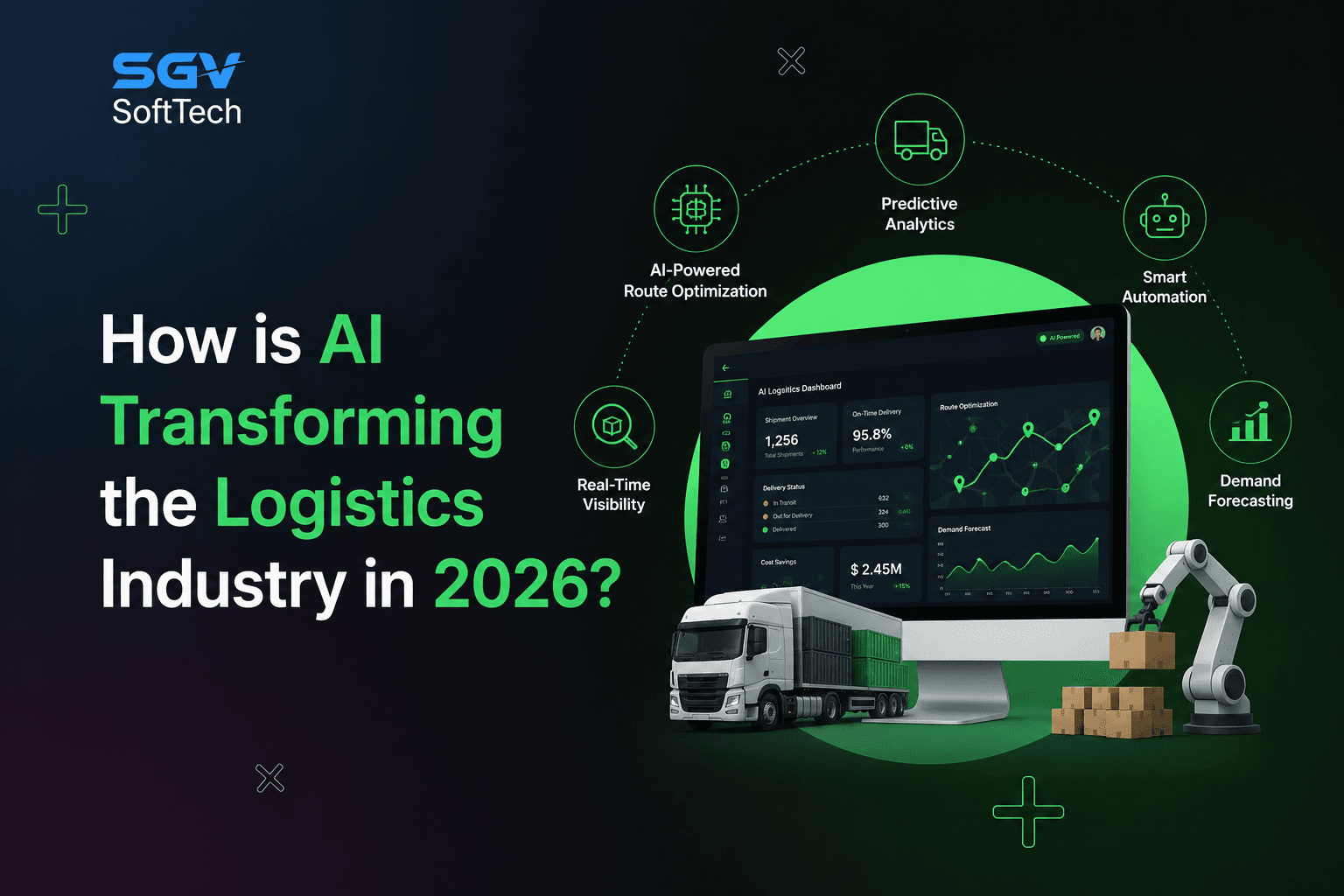
In this blog, we’ll explore how AI is transforming the logistics industry with its benefits, challenges, applications, and future trends.
Quick AI in Logistics Market Insights
Let the numbers speak:
- AI in logistics is projected to reach $242.43 billion by 2034, at a CAGR of 44.69% from 2025 to 2034.
- AI in logistics and supply chain can reduce costs by 15%, boost services by 65%, and improve inventory levels by 35%.
- Gartner’s data shows that 60% of supply chain challenges will be managed through AI technology by 2031without human interference.
Key Takeaways
- Logistics includes transportation, warehousing, inventory management, order fulfilment, and last-mile delivery, as well as planning and managing goods to move from one place to another. It ensures on-time delivery to customers.
- The cost to develop an AI-driven logistics app typically ranges from $10,000 to $ 500,000+ and more, depending on the data complexity, preparation, AI model training, and other technology integrations.
- Major challenges faced by businesses and developers are poor data quality, lack of technical expertise, high operational costs, integrations, and security and privacy concerns.
- Route optimisation, dynamic pricing, smart warehousing, automation, robotics and automated delivery scheduling are shaping the logistics industry.
What is AI in Logistics?
Using artificial intelligence technology in the logistics industry to manage logistics processes, optimise routes, automate warehousing, and forecast demand.
How logistics works:
- Order placed by a user
- The logistics company receives the info
- Check whether the product is available or not
- Manage inventories
- Pack the order
- Optimise the route for fast delivery
- Deliver products on time
AI in logistics simply makes the delivery process faster and more convenient for logistics companies by scheduling orders, automating the process, predicting demand to manage stocks, packing the order, providing routes for fast delivery, and enhancing efficiency. But how does AI in logistics support every stage?
Let’s understand it with logistics stages and AI technology through the table:
| Logistics Stages | AI Technology | Outcomes |
| Placed an Order | AI chatbots and agents | Fast-track receiving |
| Inventory Check | Machine learning | Demand forecasting and managing stocks |
| Product Packaging | Warehouse robotics and automation | Reduce manual mistakes and manage labour shortages |
| Dispatch & Routing | IoT sensors and devices | Route optimisation, faster delivery and lower fuel consumption |
| In-transit Tracking | Order tracking and predictive ETA | Reduce delays and improve on-time delivery |
| Fraud Detection & Return Scams | Machine learning, GPS trackers | Reduce fraud and build user trust |
| Customer Support | AI chatbots and assistants | Increase user reliability and enhance brand image |
Benefits of AI in Logistics
Businesses and logistics companies are leveraging AI in the logistics industry to streamline workflows, enhance decision-making, improve efficiency, and reduce operational costs. It not only helps businesses but also improves the overall user experience through accurate order deliveries, real-time shipment tracking, 24/7 customer support, and clear communication.
Reduce Costs and Enhance Efficiency
Using AI technology in logistics automates daily tasks such as scheduling, tracking, managing orders, packaging, and processing returns. It helps businesses to lower additional costs of fuel consumption and transportation.
Note: Leveraging an AI system can reduce fuel costs by 15% annually.
Maximise Profit
Businesses can maximise revenue through forecasting demand and reduce operational costs. Enhance the process through automation, order and inventory management.
Improve Inventory and Fleet Management
Machine learning analyses user behaviour and market requirements and provides predictive data for product demand, which helps to manage stock and demand accuracy. With AI, a logistics company manages warehouse commodities and uses RFID(Radio Frequency Identification) to track vehicles, drivers and equipment automatically.
Better Delivery System
Logistics companies can improve their on-time delivery system with efficient stock management, route optimisation, and transportation management.
Minimise the Return Rate
AI algorithms help to understand user behaviour and product demands, which helps to create personalised profiles and recommend similar items to reduce the return rate.
Brand Image
Implement AI technology for faster delivery, easy returns, refund policies, and regular delivery updates to build user trust and improve brand credibility.
It helps to lower carbon emissions, enhance customer experience and improve delivery accuracy.
AI Use Cases in Logistics
In 2026, AI in logistics and supply chain is beyond automation; it expands to entire supply chain management. From order placement to refund initiatives, it is transforming the traditional way of logistics, whether it's forecasting user demand, managing stocks, optimising routes, real-time order tracking or data-driven decision-making.
Route Optimisation
Route optimisation refers to finding the most efficient paths to deliver the product on time.
It helps to deliver products fast, reduce travel distance, fuel consumption, and improve brand reliability. It can reduce fuel costs by 15-20% by managing real-time traffic and weather analysis. This technology is widely used in on-demand courier delivery for an efficient delivery system.
Forecasting Demand and Supply
Forecasting demand and supply means understanding customers’ future demands and aligning resources with inventory and shipping. Predictive analysis helps to prevent shortages and overpricing, which offers 20-30% demand accuracy.
Robotics and Automation
AI automation and robotics transform logistics by speeding up warehouse processes, automating picking, packaging, and enabling faster order delivery. It boosts work efficiency, reduces handling expenses, and decreases them by up to 42%.
Customer Support Services
AI-powered chatbots support customer service through instant query resolution, handle delivery updates, track shipments, handle return requests, and initiate refunds. It helps to improve customer engagement and reduce human dependency for support.
Predictive Maintenance
IoT sensors and machine learning help to predict the failure of equipment and vehicles before it happens. With real-time alerts, machine learning observes patterns and analyses the abnormalities. It also helps with scheduling servicing and reduces maintenance costs.
Risk Management and Fraud Detection
Using machine learning, behavioural analytics and computer vision, detect unauthorised access, suspicious activity and hidden dangers. It includes fake invoice analysis, carrier detection and theft prevention. Logistics businesses use risk management strategies such as real-time tracking with IOT devices, predictive maintenance and behavioural patterns.
How Much Does it Cost to Implement AI in Logistics?
Implementing AI in the logistics industry in 2026 depends on the complexity of data, choice of software, data preparation, ready-made and customised models. Most logistics companies deploy AI for specific use cases instead of updating the entire ecosystem.
Real-world cost drivers for AI in logistics:
- Data infrastructure
- Software and Model Development
- Integration of ERP, TMS (transportation management systems), and warehouse management systems (WMS)
| App/Software Type | Estimated Cost | Timeline |
| Proof of Concept(PoC) and MVPs | $10,000-$30,000 | 1-6 weeks |
| Production Features | $40,000-$180,000 | 2-6 months |
| Enterprise Platform | $190,000-$500,000+ | 6-18+months |
Also check: Cost of developing AI-powered mobile apps
Challenges in AI Adoption in Logistics & How to Overcome Them?
AI adoption in logistics requires strategic planning, a skilled team, the right technology infrastructure, and accurate data. Many businesses and developers face obstacles such as high costs, integration with other systems, legacy systems, data security, and privacy concerns. However, these challenges can be overcome by investing in modern technologies, correct data preparation, training programs and hiring the right mobile app and software company.
High Implementation and Maintenance Costs
Leveraging AI technology in mobile apps is expensive and requires more budget than a simple logistics mobile app due to model training, advanced infrastructure, integration with other systems, employee training, and maintenance.
Overcome:- Address major cost factors such as route optimisation, infrastructure, and demand forecasting. Adopt cloud-based AI platforms to scale gradually.
Data Quality
AI systems rely on real-time, accurate, and authorised data; poor data quality can lead to inaccurate and inconsistent logistics activities. It can negatively impact decision-making and lead to inaccurate predictions.
Overcome:- Improve data quality by collecting clean, accurate, and real-time information. Regular data auditing, monitoring, and improving AI performance.
Integration with Existing Systems
An old and outdated system can not compatible with modern technology can slow down performance; a lack of modern features and functionalities can make the logistics system fail.
Overcome:- Use API and middleware to connect with a new and advanced system.
Skill Shortage
Many logistics companies lack skilled employees and technical expertise, which are necessary to utilise AI in the logistics industry.
Overcome:- Partnership with AI providers for specific expertise, train existing team members, organise training programs to upskill them.
Data Security and Privacy Concerns
As AI in the logistics industry processes a large amount of data, it can raise data security and privacy issues, such as disclosure of sensitive business & customer information and data breaches.
Overcome:- Implement security measures and privacy compliance regulations such as data encryption, multi-user authentication, continuous security audits, GDPR, DPDP Act(India), and CCPA(US).
Leading mobile app and web development companies implement the best practices for secure authentication in mobile apps.
Future of AI in Logistics
The future of AI in logistics is promising, leveraging modern technologies such as machine learning, AI assistants, generative AI, and route optimisation to enhance logistics services.
Smart Warehouse
From packaging to picking, smart warehouse robots and automation play an important role in streamlining logistics operations.
Example:-
- Autonomous mobile robots (AMRs): Move items from one place to another
- Automated Storage and Retrieval Systems (AS/RS)
- Collaborative Robots (Cobots): Heavy lifting, packing, and sorting
Dynamic Pricing
AI and machine learning analyse a large amount of data, customer patterns, market demands, and real-time data to adjust optimal pricing. AI in the logistics industry help to manage the pricing of products, fuel, and vehicles. It also offers eco-friendly pricing options for sustainable development.
- Maximise profit
- Allow businesses to stay competitive in the market
- More scalable pricing
- Enhancing customer experience
- Boosting sales
- Real-time pricing updates
Vehicle Route Optimisation
Route optimisation is a major AI use case in logistics for fast deliveries. By analysing real-time data on live traffic, weather, last-mile and sudden delivery changes, it provides the shortest and fastest paths for drivers to deliver on time.
Generative Logistics in Planning
Generative AI helps to reduce additional costs and improve efficiency.
- Document Generation: It generates shipping labels, invoices, and customs forms.
- Report & Analytics Generation: It generates reports.
- Supply Chain Scenario Planning: Plan for delays and other sudden events
- Knowledge Base & SOP Generation: It helps to generate step-by-step documentation and workflows for better execution of logistics.
Automated Delivery Scheduling
Automated delivery scheduling is a system that uses software and tools to manage orders, shipments, tracking, inventories, on-time product delivery, returns and easy refunds without manual support. It reduces labour costs, dependencies on manual work, minimises errors and ensures express delivery.
Ready to Build an AI-powered Logistics App or Software?
Logistics has become a necessity for every sector because of the rising demand for online services. Not just product purchasing, but from food delivery to pharmacy delivery, logistics services ensure a hassle-free daily life and provide a seamless user experience.
However, implementing AI is not just technical coding; it relies on real-time data that requires accurate and correct information. Inaccurate data collection can affect the entire process.
Embracing businesses improve routes, predict demand, automate processes, and improve customer services.
Building an AI-powered logistics app or software requires proper planning with clear project requirements, and hiring a logistics app development company is vital.
THE AUTHOR

Ishan Ojha
CEO of SGV SoftTech
Ishan Ohja is the CEO of SGV SoftTech, a global digital development company. He specializes in web development, mobile apps, AI solutions, and custom software development. Through his blogs, he shares insights on emerging technologies, digital innovation, and strategies that help businesses succeed in the digital world.
How is AI transforming the logistics industry?
AI is transforming the logistics industry through predictive analytics, generative AI, machine learning, AI chatbots, robotics and automation. By analysing customer behaviour, local supply chains, market demand, and competitors, it helps businesses manage stocks, fleets, and inventories. From placing an order to easy returns, it enhances the customer experience by offering a fast, easy and convenient delivery system.
What AI technologies are used in logistics?
- Robots and automation for smart warehousing
- Machine learning for identifying patterns and improving decision-making
- AI chatbots for customer support
- Computer vision for tracking inventories and quality control
- IoT devices for fleet management (tracking, managing, and safety)
- Predictive analysis for demand forecasting and ETA (estimated time of arrival)
How does a logistics app and software development company ensure security and privacy?
As a reliable custom logistics software development company, we implement security and privacy measures such as data encryption, role-based access control, multi-factor authentication, and secure third-party API and cloud hosting services. Our team employs regional privacy regulations such as GDPR and CCPA to ensure the privacy of local users and drivers.
How is AI used in logistics?
AI is used in logistics to automate repetitive tasks, optimise supply chain operations, improve transportation management, enable real-time shipment tracking, forecast demand, optimise delivery routes, and streamline return management.
How long does it take to develop an AI-powered logistics application?
Developing an AI-powered logistics application depends on the project complexity, AI integrations, data readiness, model training, security, and compliance. However, the standard timeline is:
- AI Chatbot or Virtual Assistant: 2-4 months
- Enterprise AI Platform: 6-12+
- Predictive Analytics Platform: 4-8 months