AI in E-commerce: Use Cases, Benefits, Challenges & Trends 2026
Updated: 12 Aug 2026
199 views
Intro
The shopping landscape has changed drastically since COVID-19; people prefer digital shopping for more convenience, affordable options, accessibility, and fast services.
The e-commerce industry continues to grow, and it requires innovative ways to ensure long-term market stability and improve customer experience. That’s why businesses are implementing Artificial intelligence in e-commerce.
AI in e-commerce platforms is a digital opportunity for businesses to improve customer engagement, enhance decision-making, generate more revenue and connect with global audiences. As a result, businesses can enhance the overall performance of the e-commerce platform.
Through this guide, we’ll explore how AI transforms traditional shopping methods into a modern shopping platform, its advantages, key applications, and challenges.
Quick Summary
- E-commerce platforms are rapidly growing because of the rise of digitalisation, the popularity of online shopping, and convenience.
- Before implementing AI in e-commerce, conduct research based on customer interests and market demands.
- The major challenges of using AI in e-commerce are maintaining data accuracy, real-time personalisation, and relevance to customer behaviour.
- The modern trends of artificial intelligence in e-commerce offer higher user personalisation, virtual try-ons, automated detection of fake profiles, unauthorised activities, and financial scams.
- A leading e-commerce development company offer to develop digital platforms, such as e-commerce apps and websites.
Key Market Overview
- 86% of customers check reviews on the online site but end up buying offline.
- The global AI in retail market size is projected to reach $40.74 billion by 2030.
- AI is significantly reducing operational costs in e-commerce by 2030.
What is AI in e-Commerce?
The implementation of AI technologies, such as machine learning, computer vision, and automation, offers personalised services. It automates and optimises the entire shopping process.
It allows businesses to analyse customer data, suggest personalised recommendations, streamline operations, improve efficiency and forecast supply & demand.
AI changes the way customers shop and transforms the traditional way of shopping.
Modern online retailers are using AI in e-commerce to improve customer engagement and automate daily tasks to enhance the e-commerce ecosystem.
Using AI in e-commerce helps businesses to understand customer behaviour and market demands, which increases engagement and drives sustainable growth.
If you are thinking, ‘How can AI be used in the e-commerce industry?’, then in the next segment, we’ll talk about the top use cases of artificial intelligence in e-commerce.
Top Use Cases of Artificial Intelligence in E-commerce
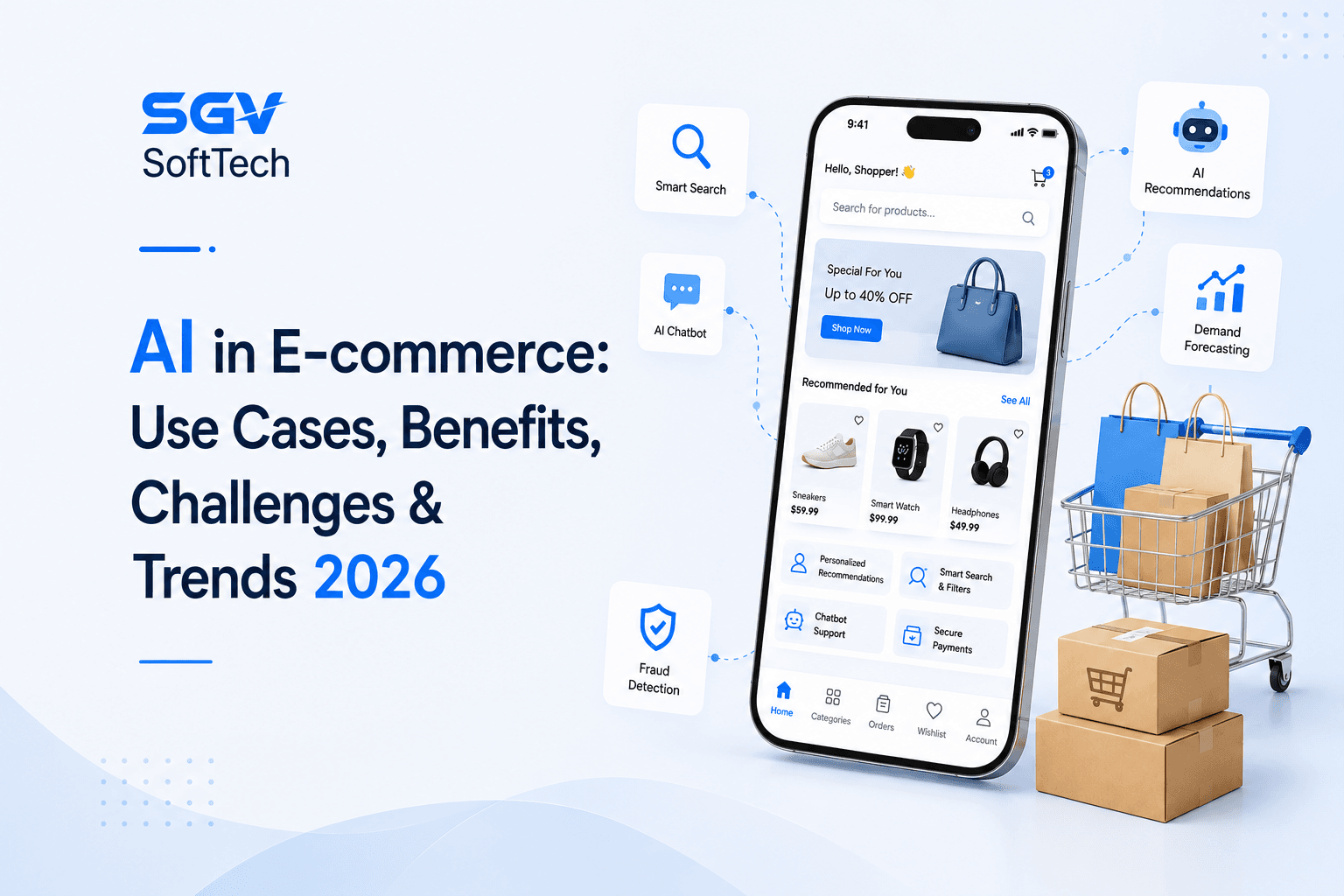
By leveraging AI in e-commerce, businesses can optimise pricing, improve customer support, customise the shopping experience, and make better decisions. Here are the top use cases of AI for e-commerce that impact the online retail market.
Personalised Recommendations
AI analyse the previous shopping browsing history, cart data, and wishlists to recommend highly customised products and predict what exactly customers want. It reduces the scrolling time and enables early checkouts.
Smart Search & Filters
AI in e-commerce understands user search intent and helps to suggest products by applying filters(brand/categories/price) to easily find.
Virtual Assistant and Conversational Chatbots
Modern AI bots help customers by suggesting items for specific events, solving queries, processing returns and refunds. It uses NLP(natural language processing) to understand users' problems and conversations.
Image/Voice Search
Imagine you want to search for a product, but you don’t know the exact name; that’s how AI-enabled image and visual search works: either customers can describe the product or search by image.
Virtual Try-ons
Integration of AI and AR, virtual try-ons, allows users to visualise makeup, clothes and footwear to try in real time; it reduces the return rate and increases customer engagement.
Supply-Demand Forecasting
By collecting data on market sales, new trends and historical data, machine learning can forecast supply and demand. It helps to manage stocks, balance the supply chain, and provide external data like weather and traffic conditions.
Dynamic Pricing
Before buying anything online, users check the pricing on many e-commerce platforms and tend to the most affordable option. AI tools analyse the dynamics of pricing, like competitors' prices, current market prices, manufacturing costs and real-time demand. It automatically adjusts prices according to product demand and market conditions.
Fraud Detection
AI continuously monitors user behaviour and financial transactions to detect fraud, scams and fake profiles. It protects consumers' data and merchant revenue.
Customer Support
Customers face many problems from searching for a product to its delivery. Except for chatbots, AI resolve return issues, initiates a refund, and performs sentiment analysis. It ensures 24/7 availability, consistent support, and increased user satisfaction.
Predictive Analysis
Predictive analysis utilises AI and machine learning to analyse user behaviour, sales trends, market and seasonal demands. Businesses can work on customer preferences, future demands, market fluctuations, and real-time data to make proactive decisions instead of just guessing.
Read more to know how much does a e-commerce app development costs?
Benefits of Using AI in e-Commerce
Artificial Intelligence in e-commerce has become an essential factor for modern shopping. Whether it’s improving the user experience or expanding the reach, it helps businesses to achieve high ROI and long-term profitability.
Here are some key benefits of AI for e-commerce :
Enhance Customer Experience
Artificial intelligence in e-commerce offers user personalisation that suggests products based on users' previous searches. Improved customer experience through early checkouts, secure payment transactions, push notifications, and reminders for abandoned carts.
High-Conversion Rate
By suggesting complete the look ’, personalised recommendations, smart search, visual images, and customer support. Customers are more likely to use e-commerce platforms(Website/App) rather than offline stores.
Increase Order Volume
Using AI in e-commerce increases the order volume by offering accessibility, more options, comparing pricing, seasonal sales, discounts, and coupons.
Improve Online Visibility
Modern e-commerce platforms focus on improving Google ranking through SEO-optimised product specifications, search trends, and competitor analysis to attract organic traffic.
Better Decision Making
AI analyses market trends, historical data, user demand fluctuations, and competitive metrics to aid in better decision-making to increase revenue and market value.
Automated Customer Service
AI chatbots and assistants help customers by providing real-time responses, 24/7 customer support, handling queries, tracking and processing orders. This reduces response time, and businesses can save their time for handling more complex requests.
Challenges of Utilising AI in e-commerce
While AI offer immense benefits for businesses to grow, it also raises some major challenges like poor data quality, user privacy, data security and algorithm bias. Understanding these challenges helps to build a scalable e-commerce platform.
Security & Privacy
E-commerce platforms use AI, which processes the vast amount of personal data of customers to understand their behaviour. It can raise the concern of data breaches, cyberattacks, and misuse of sensitive information. Poor security and privacy can affect the customer’s trust in and reliance on the brand.
Solution: Implement zero trust architecture, end-to-end encryption, and secure logins. Enforce data privacy regulations such as GDPR, obtain user consent before using the data, and follow platform compliance guidelines.
High Implementation Costs
Using AI for e-commerce platforms with the custom requirements of businesses, building from scratch, preparing correct data and information requires experts, which is costly. Regular audits, security audits, fixing bugs, and resolving technical errors are mandatory for maintaining an AI-powered e-commerce platform.
Solution: Instead of building from scratch, use modern SaaS platforms such as Shopify, Wix e-commerce, and BigCommerce for cost-effective options.
Complex legacy System
A complex legacy system refers to an outdated IT environment using old software versions, frameworks, and languages that many businesses still use despite technical hurdles.
While AI in e-commerce is handling the massive data sets of users' personal information, it can lead to data security and user privacy concerns.
Solution: Using modern middleware and APIs. Choose the right modernisation method: rehosting, refactoring, or microservices(break down a monolithic system into small services to easily communicate with modern AI-driven e-commerce platforms).
Data Quality
AI models rely on data; using incorrect, siloed, and duplicate data can lead to a product mismatch and affect the outcomes.
Solution: Prepare for the correct and authorised data collection, implement automatic data cleaning tools, and use a single source of data like a robust CRM.
AI Algorithm Bias
As AI models heavily rely on the data that is prepared by the human development team, this raises the concern of human bias. It can impact the outcomes with discriminatory data, wrong personalised recommendations, and demographic biases.
Solution: Using a diverse development team to bring different perspectives and representative data. AI models require continuous testing, audits, and data quality. Use AWS AI Fairness Tools to ensure fairness and mitigate AI bias.
How to Implement AI in E-commerce Businesses?
Implementing artificial intelligence in e-commerce requires clear strategic planning, quality data, and business objectives.
Determining Your Business Goals
Know your business objectives for a clear implementation. The requirements differ from business to business. Defining your goals can improve marketing and brand awareness.
Understand Customers’ Pain Points
Before starting to develop an e-commerce platform, you need to understand what your users really want and the pain points that connect customers to your app. User shopping patterns, behaviour, and in-depth market research help to better understand the customers.
Technical and Data Audits
To provide correct and authorised data, it's important to prepare, collect, and audit data before utilising it. Choosing the right AI technical infrastructure is crucial to implementing AI in e-commerce.
Resource Management & Budget
As AI app development services cost a lot, it requires proper resource management and budget planning for better execution.
Start with a Small Project
Don’t build an advanced e-commerce app at the initial stage; focus on the core e-commerce app features. It’s best to invest in MVPs and pilot projects to understand users. Collect their reviews on features and functionality to make it advanced and user-focused.
Implement Ethics and Compliance
Boosting the credibility of artificial intelligence in e-commerce is important to build loyal customers in a highly competitive market. Users prefer security and privacy over any features. Apply security and compliance to protect users' data and information.
Competitive Edge
Analyse user patterns, market demands, and competitor analysis to gain a competitive edge for long-term business growth and user engagement.
Real-World Example of AI in e-commerce
Modern retailers such as Amazon and Shopify leverage AI technology in e-commerce to stay competitive in the market and drive revenue.
Amazon
Amazon use the AI assistant named ‘Rufus’ to directly connect with customers and resolve queries with quick responses. Rufus and Alexa both help users to track orders, preview history, compare prices, and hyper-personalise products. Smart search allows customers to find a specific product without scrolling through multiple pages.
Shopify
Shopify uses an AI support assistant for 24/7 customer support to resolve refund queries, to initiate returns, and recover abandoned carts.
Semantic AI understand the user intent and offers personalised recommendations like birthday dresses, winter clothes, etc.
Generative AI creates high-quality product images and SEO based product descriptions to rank high on Google.
Waltmart
Walmart harnesses advanced AI features such as conversational shopping, predictive inventory management, and alternative product suggestions.
Final Thoughts
As AI technology evolves in every sector, customers expect more than just products; they expect personalised recommendations, a seamless shopping experience, instant support and quick responses.
From delivering an engaging shopping experience for customers to empowering retailers to make smarter decisions to achieve better outcomes.
Online shopping is rapidly evolving, and AI in e-commerce plays a key role in shaping the future of e-commerce platforms as digital marketplaces. Businesses can drive more revenue, strengthen brand value, innovate, and accelerate long-term success by adopting the right AI solutions.
Whether you're a startup or an established online retailer, artificial intelligence in e-commerce can provide competitive advantages. AI technology has major concerns of data security, privacy, biased algorithms, and poor data quality, but partnering with the right mobile app development company helps to ensure security and scalability by leveraging a modern tech stack.
At SGV SoftTech, we build a future-ready e-commerce platform with competitive advantages.
THE AUTHOR

Ishan Ojha
CEO of SGV SoftTech
Ishan Ohja is the CEO of SGV SoftTech, a global digital development company. He specializes in web development, mobile apps, AI solutions, and custom software development. Through his blogs, he shares insights on emerging technologies, digital innovation, and strategies that help businesses succeed in the digital world.
How is AI transforming e-commerce businesses?
The traditional act of shopping has been replaced by modern e-commerce platforms (Websites/App) by offering a seamless user experience, automating daily operations, improving marketing and inventory management. AI-powered tools help businesses to generate product images, SEO based specifications, improve Google ranking and online visibility.
How much does e-commerce app development cost?
E-commerce app development cost depends on various factors such as app type, feature set, app complexity, team expertise, developers' location, and technology integrations.
- A simple vendor e-commerce app: $15,000-$50,000
- Multi-vendor e-commerce app: $50,000-$150,000
- Quick commerce/hyper local app: $30,000-$80,000
Building a custom e-commerce app can be costly due to building from scratch, tailor-made design elements, and development based on business requirements.
How is AI used in e-commerce?
AI for e-commerce is used in personalised product recommendations, dynamic pricing optimisation, automated content generation, conversational AI, smart visual/voice search, predictive market analysis and inventory management.
Is AI technology in e-commerce worth it?
From personalised recommendations to predictive analysis, using AI in e-commerce is not an option any more; it has become a necessity for businesses that want to achieve long-term market profitability, increase customer engagement, enhance customer support, and build brand value. So, yes, AI technology in e-commerce is totally with it. However, AI technology itself raises many challenges and issues, such as data security and privacy, but with the implementation of proper branding, platform, and security measures, the risks can be reduced.
What are the major challenges of using AI in e-commerce?
Using incorrect information leads to poor product recommendations; high maintenance costs, data security and privacy concerns are major hurdles in leveraging AI in e-commerce. Unethical use of AI can impact customer trust and reliability.